Reinforcement vs. Punishment: What Actually Changes Your Child's Behavior
The Quick Answer
Reinforcement increases a behavior; punishment decreases it. "Positive" means adding something and "negative" means removing something. Punishment can stop a behavior in the moment but may bring fear, resentment, or hiding. Positive reinforcement, noticing and rewarding what you want to see, tends to build lasting habits. Most parents get the best results by leaning heavily on reinforcement and using calm, fair consequences when needed.
Picture this. Your seven-year-old throws a toy across the room. It hits the wall and leaves a mark.
You react fast. "That's it! No tablet for a week!"
He cries. He stomps to his room. The toy-throwing stops, for today.
Two days later, it happens again. Only this time, he checks to see if you're watching first.
Sound familiar? Most of us parent the way we were parented, and a lot of us were raised on punishment. It feels like it works because the behavior stops in the moment. But if the goal is a child who makes good choices even when you're not watching, there's a better tool.
The Science Behind Behavior: A Quick Guide
Psychologist B.F. Skinner is known for his work on operant conditioning, the idea that behavior is shaped by its consequences. His work built on earlier research by Edward Thorndike. One of the biggest takeaways is simple: behaviors that are reinforced tend to be repeated.
The terms get confusing, so here's the key:
- Reinforcement makes a behavior more likely to happen again.
- Punishment makes a behavior less likely to happen again.
- Positive means adding something.
- Negative means taking something away.
Put those together and you get four types:
- Positive reinforcement: adding something good to strengthen a behavior. Your child cleans their room and gets extra playtime.
- Negative reinforcement: removing something unpleasant to strengthen a behavior. Once your child starts their homework, you stop the reminders. They learn that starting quickly makes the nagging go away.
- Positive punishment: adding something unpleasant to weaken a behavior. Scolding a child or adding an extra chore after they misbehave.
- Negative punishment: removing something good to weaken a behavior. Taking away tablet time after they throw a toy.
Here's the one most parents mix up: negative reinforcement is not punishment. It's still about strengthening a good behavior, just by taking away something the child doesn't like.
Does Punishment Work for Kids?
Sometimes, in the short term. It can stop a behavior quickly. But it has real downsides when it becomes the main tool.
- It teaches what not to do, not what to do. The child learns to stop, but not what the better choice is.
- It can create fear or resentment. Harsh punishment may damage trust and, over time, can lead to more aggression, not less.
- It can teach hiding. Kids learn to avoid getting caught instead of learning to make better choices.
- It doesn't last without you. When the punisher isn't around, the behavior often comes back.
That doesn't mean kids should never face consequences. Fair, calm, related consequences are part of life. The problem is when punishment is the only tool in the box.
A helpful rule of thumb: try to notice and reinforce good behavior far more often than you correct bad behavior. When the balance tips toward encouragement, kids have a reason to keep choosing well, and the occasional consequence actually means something.
What Should I Do Instead of Punishing My Child?
At ZENTAI, when a student makes a mistake in class, we don't yell at them, and we don't shame them. We ask two questions:
The ZENTAI Questions
"What happened?"
"What are you going to do differently next time?"
That's how we teach Responsibility, one of the Five Core Values of the ZENTAI Warrior. Own it, learn from it, move forward.
I write about this in my book, Built to Lead. Responsibility doesn't start with what happened to you. It starts with what you're going to do about it. When a child answers those two questions, they're not just avoiding a punishment. They're building the habit of owning their choices.
Try this approach at home:
- Catch them being good. Notice and name the behavior you want. "You put your shoes away without being asked. Thank you." This is the most powerful tool you have.
- Stay calm when things go wrong. Take a breath before you respond. Calm teaches more than loud.
- Ask the two questions. "What happened?" and "What will you do differently next time?"
- Use related consequences when needed. Threw a toy? The toy takes a break. Made a mess? Help clean it up. Keep it fair and connected to the behavior.
- Reinforce the repair. When your child makes it right, praise that too. "You fixed it. That's responsibility."
Go back to the toy-throwing moment. Instead of "No tablet for a week," try a calm voice, a short break for the toy, and the two questions. Then, later that day, when he plays gently, say so out loud. That's reinforcement and responsibility working together.
How ZENTAI Uses Positive Reinforcement
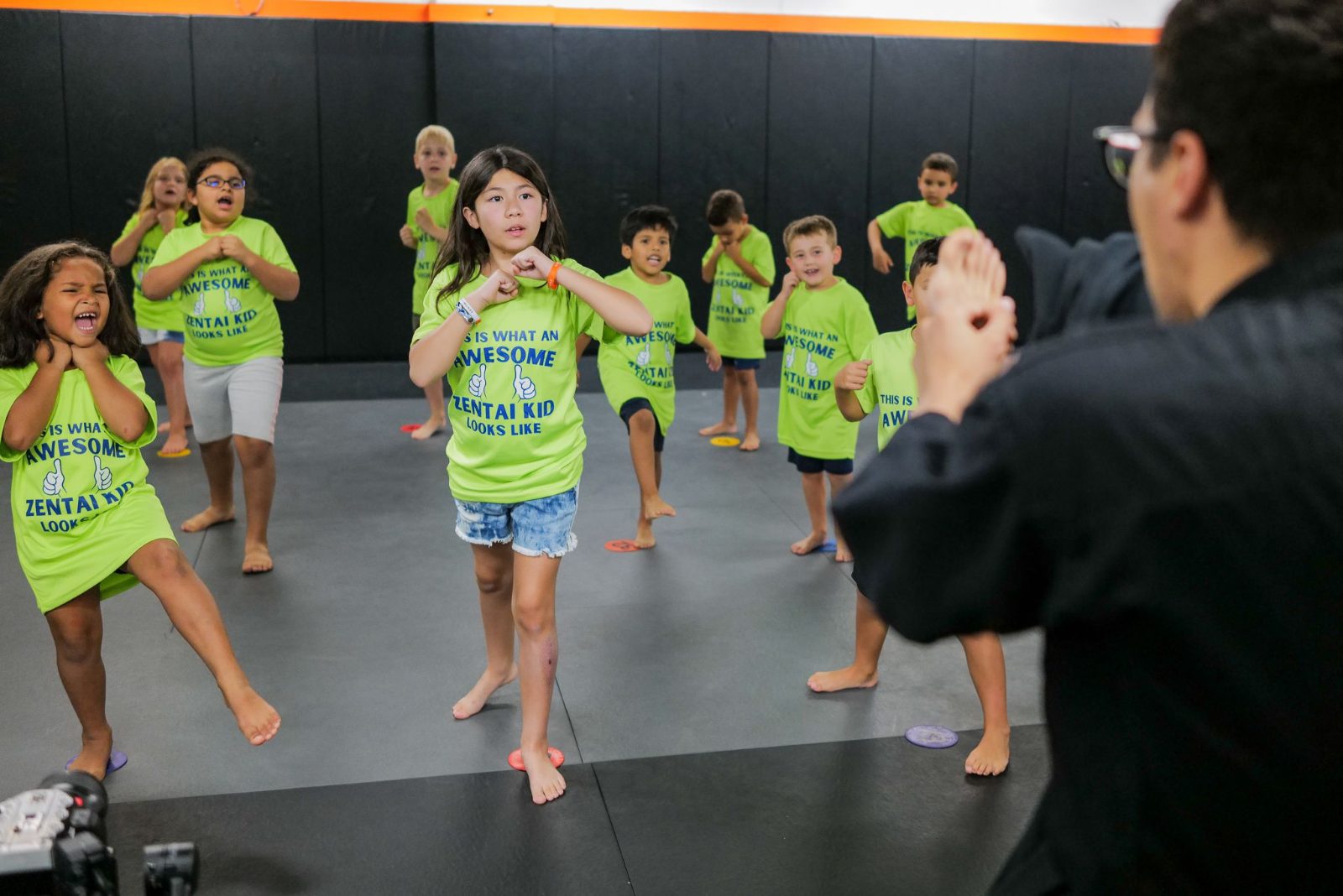
At ZENTAI Martial Arts, we are a leadership development academy that uses martial arts as the vehicle. Our kids classes follow the ZENTAI SKILLZ child development curriculum, and positive reinforcement is built into every class.
- Skill stripes. Students earn stripes on their belts as they attend class and successfully complete technical requirements.
- Belt progress. Stripes lead toward the next belt, a big, visible reward for consistent effort.
- A game at the end of class. Kids look forward to it, and it celebrates the hard work they just put in.
- Specific praise. Instructors name the effort and character they see, not just the technique.
Our instructors are trained in child development, and they coach both character and technique, so kids grow as people and as martial artists. Through Parent SKILLZ, we share these same reinforcement strategies so you can use them at home. In the ZENTAI SKILLZ program, we want kids to behave well because they're becoming good leaders, not because they're afraid.
This is more than a martial arts school. It's a village. At our 4 New Jersey locations in Belleville, Clifton, Hackensack, and North Arlington, and our location in the Dominican Republic, we're building kids who make good choices even when no one is watching.
Keep Learning With ZENTAI
- Behavior Shaping: How to Use Reward Charts and Reinforcement Schedules That Actually Work
- The Power of Positive Parenting: Building Responsibility Through Motivation, Not Fear
- Quiet Parenting: How to Stop Yelling at Your Kids
Want More? Read Built to Lead
In my book, Built to Lead: Develop Character, Master Influence, and Find Your Purpose, I explain how we teach responsibility and ownership without shame. It's written for parents to read with their preteens and teens.
Get Built to Lead on Amazon. All net proceeds support Heart of ZENTAI, our nonprofit bringing free martial arts and leadership training to children in the Dominican Republic.
See Positive Reinforcement in Action
We work with kids ages 3 and up, teens, and adults. Visit us in Belleville, Clifton, Hackensack, or North Arlington, NJ.
Book your child's first class at zentai.us or call (201) 431-5425. Watch your child work toward their first stripe.
We Rise By Lifting Others.
Frequently Asked Questions
Find a ZENTAI Location Near You

About the Author
Grandmaster Allen DePeña is the founder of ZENTAI Martial Arts, a leadership development academy with 4 New Jersey locations (Belleville, Clifton, Hackensack, and North Arlington) and 1 in the Dominican Republic, which he built alongside his wife and co-founder, Naomy. He grew up in the Bronx, trained under Grandmaster Tony Morales, and is the author of Built to Lead: Develop Character, Master Influence, and Find Your Purpose. ZENTAI was named #1 Child Development Center of the Year by Skillz Worldwide and holds a 5.0 Google rating from more than 500 reviews.
More about Grandmaster Allen →